
Experience Masterplanning
Expertise
Experience Masterplanning
Experience Masterplanning builds the user's perspective into complex masterplan and building projects from the beginning. Where the masterplanning process designs the hardware of a place, Experience Masterplanning designs its software: the vision, principles and strategy that determine what visiting it will actually feel like.
It runs alongside the physical process rather than competing with it, spanning a connected set of human-centric services — from upfront destination positioning through to wayfinding, visitor experience and post-occupancy placemaking once a place is open and in use.
The value of that perspective is what it surfaces. Working from how people will actually use a development reveals opportunities and innovations that a purely spatial process can miss, shifting the focus beyond transactions and functions to what visitors perceive, feel and remember.
We draw on combined expertise in urban, architectural, digital and visual design to bring a place's disparate elements together into a single, immersive destination.


Deeply engaged in the value of people's experience of the built environment, we capitalise on our combined expertise in urban, architectural, digital and visual design to integrate disparate elements of places into immersive destinations. We believe that defining a clear vision for places helps them define and manifest their place in the world.


Mapping visitor journeys shows us how people will actually move through a space and interact with it, physically and digitally, revealing the pain points and touchpoints that matter most to each project. That understanding of the social logic of space keeps the focus on service design that smooths navigation and transitions, and anticipates what users need before they ask.


Wayfinding is central to our practice. We have delivered wayfinding and signage systems across the transport, events, retail, sport, hospitality, commercial and cultural sectors - at scales ranging from individual buildings to multi-venue and city-scale masterplans. We use pedestrian modelling to ground every solution in real movement data rather than assumption.
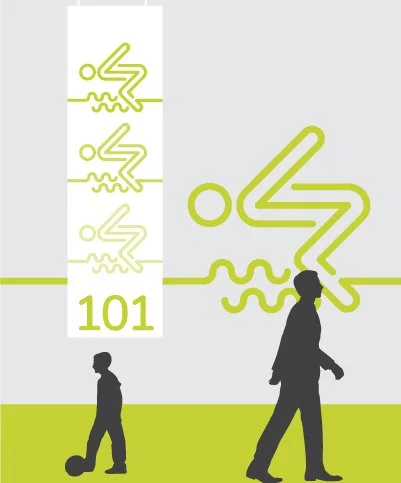

We use powerful graphic communication to tell the story of places. Spanning from public artworks and installations to urban supergraphics, place identity creates stronger recognition and sense of belonging. What makes us unique among environmental graphics practices is that we have the detailed architectural skill base to work alongside larger design teams to seamlessly integrate our work directly into the fabric of the architecture and landscape, avoiding add-on solutions.


Combining graphic, product and spatial design, we craft narrative environments for exhibitions. Each begins with a conceptual framework, a spatial interpretation of its themes that shapes form, material and graphic language together, so content and design are resolved as one rather than in sequence, from the scale of the room to the detail of the page.
Where We Practice
220 projects and counting: A global footprint from California to Europe, the Middle East, China and Australia
With studios in London, Milan and Guangzhou, we work across five continents as lead consultant, specialist subconsultant, and embedded partner within larger design teams, for clients including municipalities, cultural institutions, developers, public transport authorities and global brands.
Two of our most significant current commissions sit at almost opposite ends of the world: wayfinding consultants on the Expo 2030 masterplan team in Riyadh, the third consecutive World Expo we have shaped after Astana 2017 and Dubai 2020, and visual identity, wayfinding and signage for the West Kowloon Cultural District in Hong Kong, one of the region's most significant cultural destinations.
Our Projects
We work across a wide range of scales and sectors - from World Expos and cultural institutions to airport terminals, mobility hubs, retail masterplans and entire new cities. This breadth isn't incidental: it reflects how we work. Bringing together architects, urbanists, graphic designers and product designers from 19 countries, we approach every project from multiple disciplinary angles, starting from the specific cognitive, cultural and spatial demands of its site.
What stays consistent is our focus on the human experience of space - treating wayfinding not as a layer applied at the end of a project, but as a discipline embedded from the earliest stages of design.
People
Our work starts with people. We help our clients define the strategic positioning of their development through insight into their target audiences' needs, behaviours and motivations, gathered through direct research and spatial behaviour modelling.
Where We Work
What We Design
Vision
Research insight and client ambition resolve into a single Experience Vision and Narrative, grounded in each project's particular opportunities and constraints. It gives every stakeholder on the design team a shared, stable reference point to plan and test against, in place of subjective preference and ad hoc judgement.
Place
Memorable places have site-specific, defining characteristics - ones that can be unearthed through research into history, culture and geographical context, then translated by design into spatial form, use and story. Choreographed holistically and united by a common narrative, those characteristics turn a sequence of moments into a resonant, coherent sense of place.
Countries of Practice
User-Centric Design
We work at the intersection of disciplines that too often operate in isolation, brought together by a single focus: the user's experience of a place, built through a shared understanding of the built environment, human behaviour and visual communication.
Spatial Analysis and Methodology
We employ a methodology developed at the Space Syntax Laboratory at University College London and tested in practice for over 30 years, which forecasts patterns of movement and use within cities and complex buildings, and reveals how the layout of an environment shapes behaviour before a single sign goes up.
We use it to map how people move through, decide within and interact with a space, and to ground every design solution in that real behaviour rather than assumption.
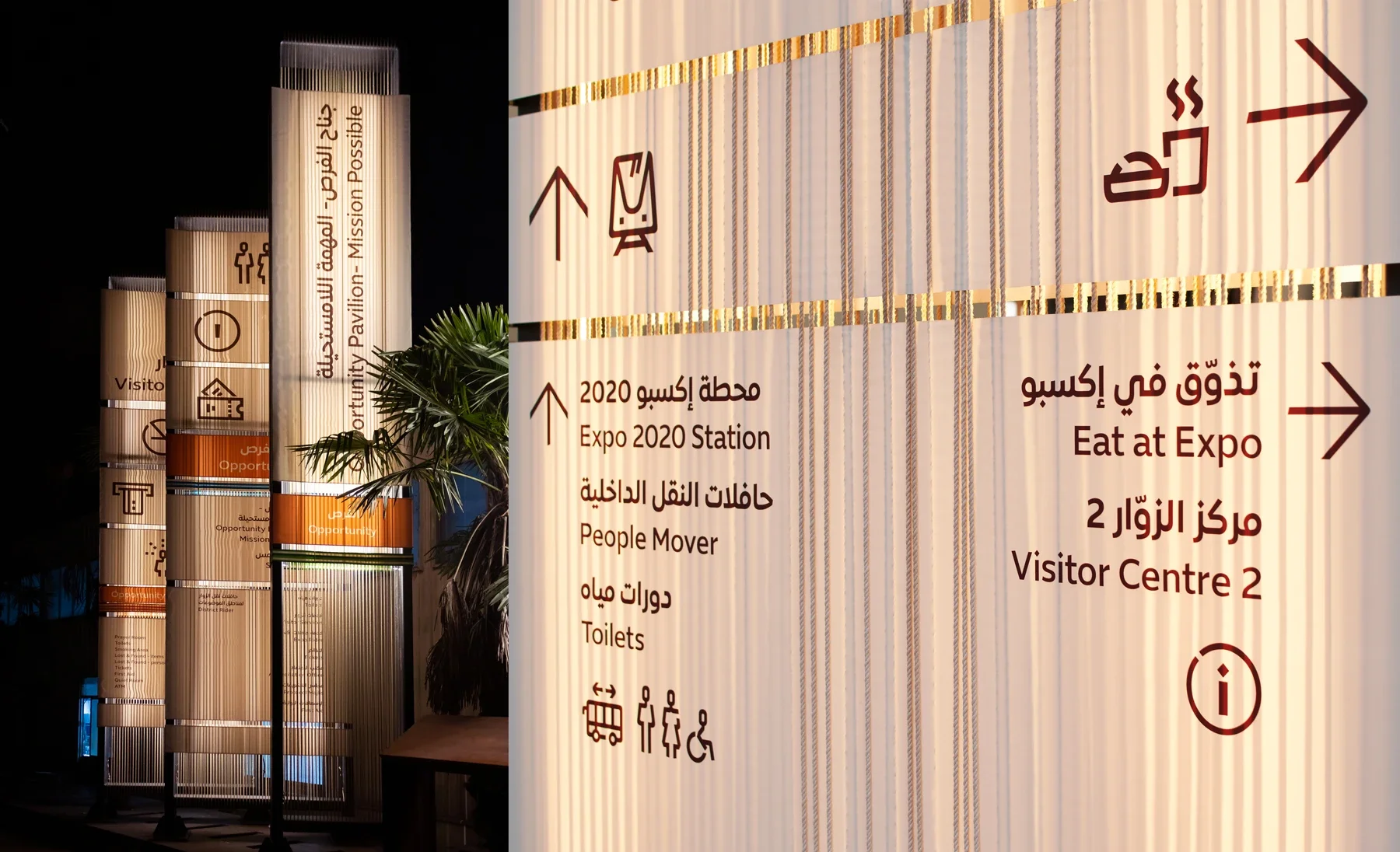
Signage for Expo 2020 during mock-up reviews
We Deliver Excellence
Our work is underpinned by meticulous attention to detail and artful execution. We aim to inspire both those we work with and those who use the spaces we design.
Making complex processes intuitive and natural
We combine strategic thinking with cutting-edge technology, using the latest analytical tools and computational models to predict and interpret movement and behaviour. Large-scale projects often generate a complex spatial framework; through our research we develop a single visual narrative and design concept that makes the whole legible. Creating topological maps - just as Harry Beck did for the London Underground in the 1930s - helps us simplify that complexity into something that feels natural and intuitive.
Bespoke Product Design
Every project begins with a close reading of its context: cultural heritage, local craft traditions and the natural landscape of the place. That research feeds directly into the physical design, so that form, material, colour, typography and mapping are resolved in relation to where the work will live rather than imported from a generic system.
The result is a signage and product design language specific to its site: one that speaks to the architecture, reflects the client's brief, and reads clearly within the cultural and social conditions of the region.
Graphic Comminication
We use graphic communication to tell the story of places, from place identity systems and urban supergraphics to public art and installations.
Our architectural skill base is what sets us apart among environmental graphics practices: it lets us integrate this work directly into the fabric of the architecture and landscape, working alongside larger design teams rather than adding it on afterwards.